Participation in the “Linear Infrastructure and Biodiversity” day organized by the DGITM
We went to La Défense to take part in this event and to lead a workshop on preserving the ecosystem services of green roadside verges.
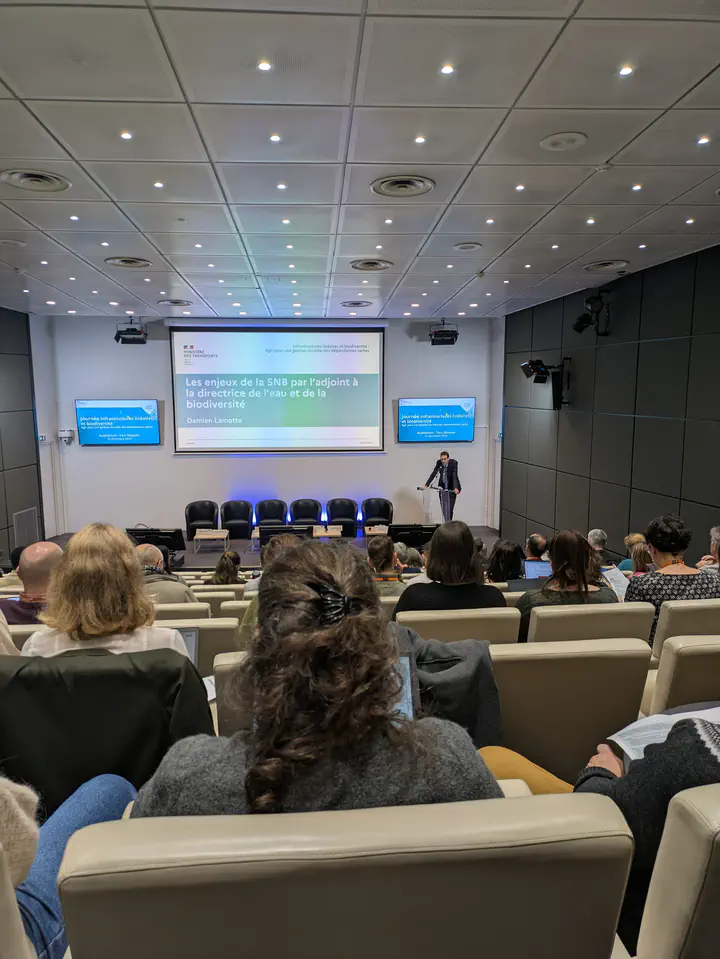
On Friday 12 December, the Directorate General for Infrastructure, Transport and Mobility (DGITM) organized a day of discussions on the theme “Transport and biodiversity: towards sustainable management of transport infrastructure.” Around one hundred infrastructure managers took part, representing a wide range of organizations such as VNF (Voies Navigables de France), SNCF, RTE, NaTran, as well as departmental councils and numerous Regional Road Directorates (DIR).
The morning was devoted to sharing experiences through two round-table discussions.
The first, entitled “Reconciling safety and environmental issues in the management of green infrastructure areas,” enabled several managers to share their biodiversity conservation objectives, the constraints they face, and the solutions they have found to reconcile these two challenges. Three main levers for successfully addressing these issues were identified:
Strengthening field knowledge: it is essential to have a good understanding of green infrastructure areas in order to plan maintenance operations according to their typology.
Working on intervention schedules: the timing of interventions is the key parameter to adjust; the challenge is therefore to identify time windows that best address the different issues.
Encouraging dialogue with State services: bodies such as the OFB and the DREAL play a support role for managers in these approaches, and it is preferable to involve them as early as the strategy definition stage.
The second round table focused precisely on field knowledge and was entitled “Digital tools in support of knowledge and sustainable management of green infrastructure areas.” Once again, managers were given the floor to present their solutions. It was interesting to note that, despite broadly similar mapping needs, each manager tends to develop their own solution independently, with specific functionalities. An ENEDIS representative then made a remark that aligns closely with our own ambitions on this topic: it could be beneficial for all interested managers to come together to jointly develop a shared cartographic tool.
The afternoon was devoted to four different workshops, and we had the opportunity to facilitate one of them alongside the Côtes-d’Armor Departmental Council, represented by Frédérique Morin. The topic, “What natural heritage exists within green infrastructure areas? How can the ecosystem services provided by this heritage be preserved?” allowed us to present the work carried out within the framework of the SAGID+ chair.
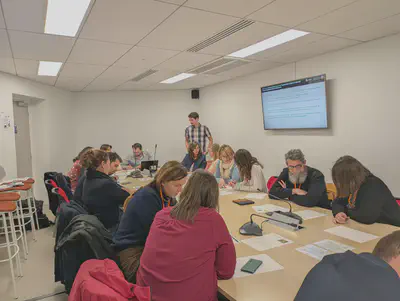
We also encouraged participants to reflect on the strategies that can be implemented to gain a better understanding of the natural heritage of green infrastructure areas.
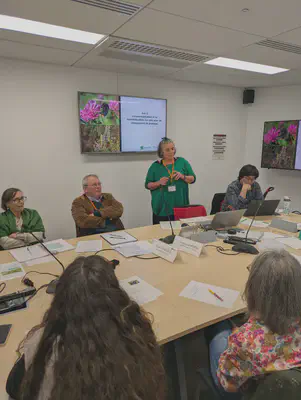
Finally, Frédérique Morin shared feedback on the change in practices she is leading in her department, with the implementation of late-season mosaic mowing. The presentation of this approach led to a discussion on the communication and awareness-raising measures to be put in place to facilitate the adoption of these new practices—among field staff, elected officials, and even users and local residents.
In conclusion, each part of the day provided key insights in support of the sustainable management of green infrastructure areas. The discussions also validated many of the lines of work already underway within the project, notably by reiterating the importance of understanding one’s territory through mapping. Assessing the impact of maintenance practices on ecosystem services will also provide the elements needed for environmentally sound and coherent planning.
We would like to thank the DGITM for organizing this event and for inviting us to lead a workshop that highlighted the research work we are carrying out.